For chemistry students · 4 minute read
What happens when aluminium chloride reacts with sodium hydroxide?
Aqueous aluminium chloride and sodium hydroxide can form a white aluminium hydroxide precipitate. Excess hydroxide can dissolve that solid.
- Balanced equation
- AlCl3(aq) + 3NaOH(aq) -> Al(OH)3(s) + 3NaCl(aq)
- Model and safety boundary
- OmniLab shows the precipitation stage only. Adding more sodium hydroxide in the browser does not model redissolving the solid.
Your study goal: Separate the first white precipitate from its later behavior in excess alkali.
Open the prepared exampleThe exact supported pair opens in a beaker. Nothing runs until you select Analyze.
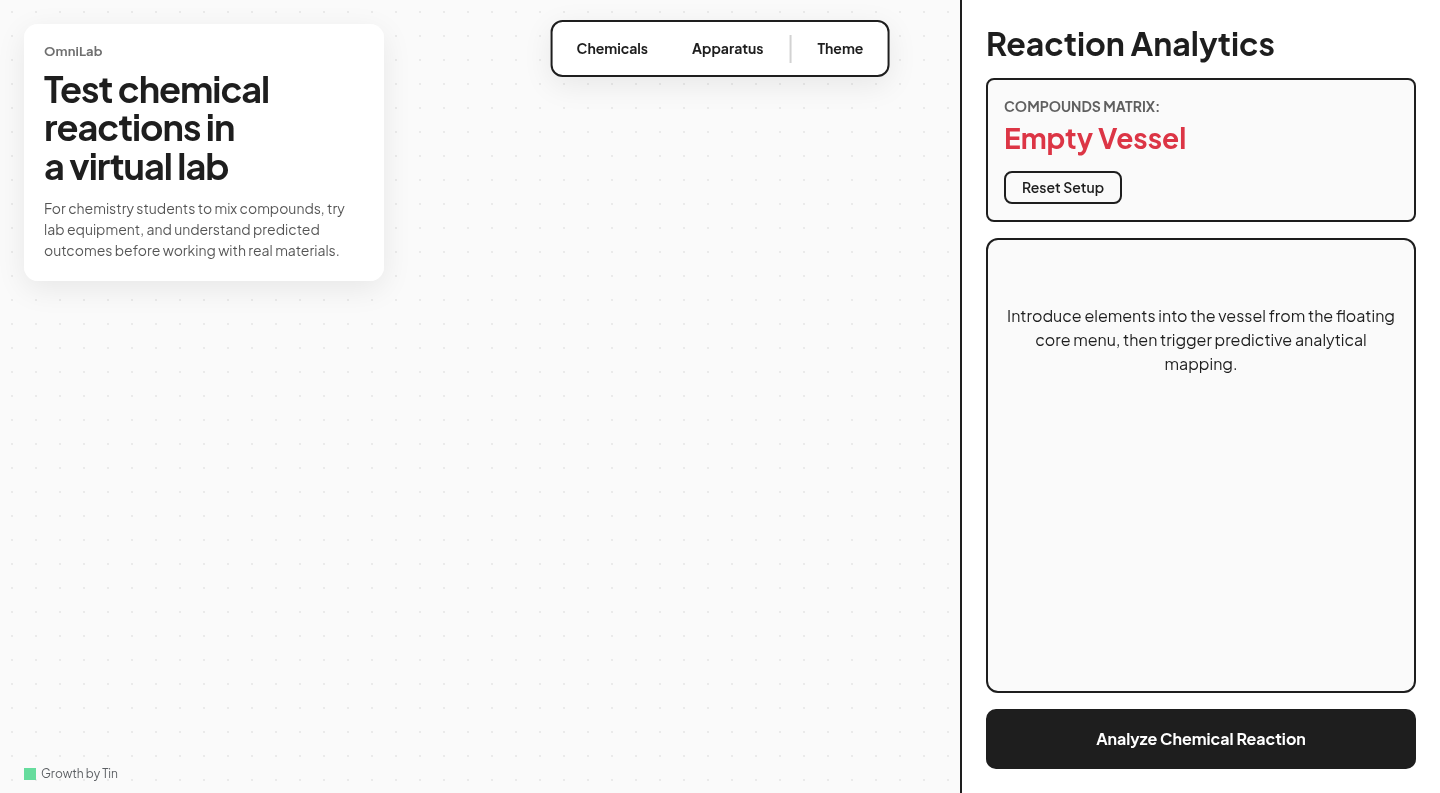
Supported prediction
AlCl3(aq) + 3NaOH(aq) -> Al(OH)3(s) + 3NaCl(aq)
What the equation means
Aluminum chloride and sodium hydroxide form a white aluminum hydroxide precipitate while sodium chloride remains in solution. Three hydroxide ions are required for each aluminum ion. Excess hydroxide can redissolve the amphoteric precipitate.
Expected observation
A white solid, with an important excess-alkali limit
The initial precipitate can look white and gelatinous. In a real solution, sufficient excess hydroxide can dissolve it. OmniLab keeps a simplified white precipitate cue and does not model that second stage.
Net ionic equation
Which ions actually form the precipitate?
Aluminium ions combine with hydroxide ions to form the solid. Hydration details are omitted from this classroom ionic equation.
Spectator ions: Na+(aq) and Cl-(aq) remain dissolved during the precipitation stage.
-
01
Balance the ion charges
One Al3+ ion has charge +3. Three OH- ions supply charge -3, giving a neutral solid.
-
02
Keep spectators in solution
Sodium and chloride ions appear on both sides of the complete ionic equation. Cancel them to show the change that forms the solid.
-
03
Distinguish the second stage
Aluminium hydroxide can react with excess hydroxide to form dissolved [Al(OH)4]- ions. That stage is outside this prepared result.
Three safety notes
Read these before any physical experiment
- 01
Wear chemical splash goggles and alkali-resistant gloves.
- 02
Add dilute sodium hydroxide dropwise to avoid excess base.
- 03
Rinse chemical splashes immediately with plenty of water.
Common questions
What students usually ask next
Use these distinctions to move from the visible reaction to the particle-level explanation.
What is the white precipitate?
It is aluminium hydroxide, Al(OH)3. The chloride and sodium ions stay dissolved during its formation.
What does amphoteric mean here?
Aluminium hydroxide reacts with both acids and bases. Its dissolution in excess hydroxide demonstrates its reaction with a base.
What equation describes excess hydroxide?
A common aqueous summary is Al(OH)3(s) + OH-(aq) -> [Al(OH)4]-(aq). This is a separate stage, not OmniLab's returned equation.
Will the browser solid disappear in excess alkali?
No. The model recognizes the selected pair, but it does not calculate amounts or complex-ion equilibria.
Keep exploring
Connect this observation to another reaction
These guides use the same pattern: predict the equation, identify the visible cue, then check what the virtual model leaves out.
See how the full virtual lab works