Ten questions · Worked answers · Matching lab examples
Practice chemical reactions you can actually check
Predict a product or observation first. Then reveal the equation and reasoning. Each example links to a supported OmniLab reaction.
Start question 1No account or payment is required in the current release.
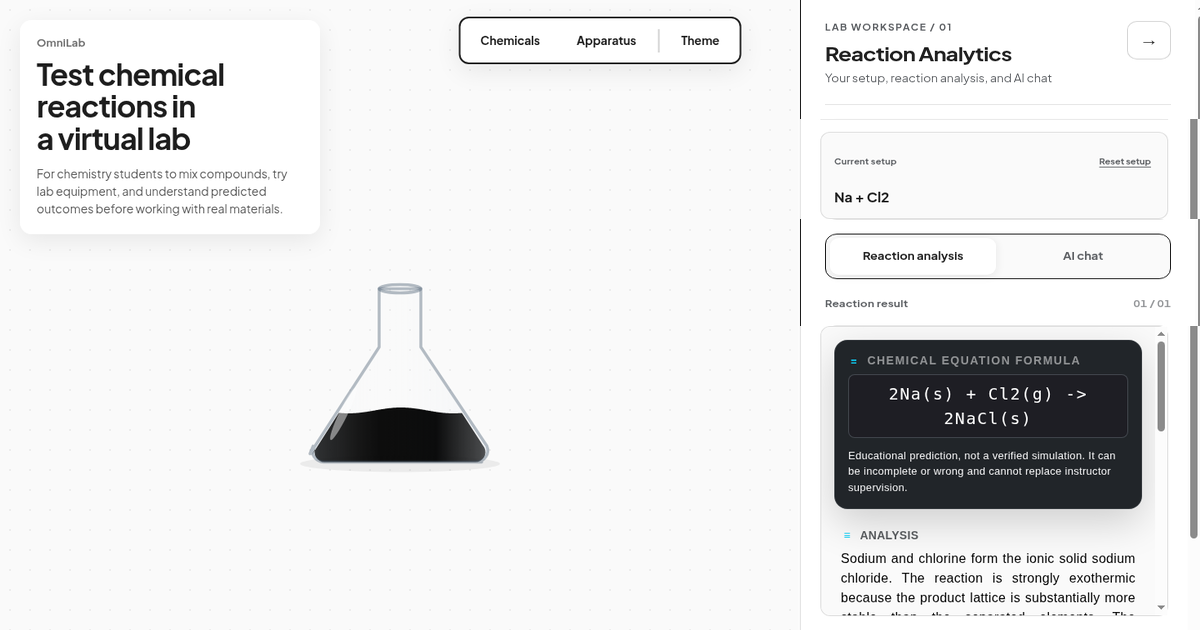 Actual OmniLab result
How to use this set
Try the question before opening its answer
For each pair, write what you expect to form. Look for a balanced equation and a clue you could discuss in class. Open the answer only after you make a prediction. The ten examples cover solids, gases, neutralization, oxidation, and metal-acid reactions.
Work through the reactions
Ten questions, several different clues
Each answer explains one useful step. The full guides go deeper after you check your work.
What forms when silver nitrate meets sodium chloride?
Both reactants are dissolved in water. Name the solid, then balance the full equation.
Show the worked answer
AgNO₃(aq) + NaCl(aq) → AgCl(s) + NaNO₃(aq)
Silver ions join chloride ions to form solid silver chloride. The white solid is a precipitate. Sodium and nitrate remain dissolved. Every element already has the same atom count on both sides, so each coefficient is 1.
Check the state symbols: (aq) means dissolved in water; (s) means solid. A white appearance alone cannot identify an unknown substance without further tests.
Read the silver chloride guide →Why does sodium carbonate fizz with hydrochloric acid?
Predict the gas and the other products. Then check which coefficients make the equation balance.
Show the worked answer
Na₂CO₃(aq) + 2HCl(aq) → 2NaCl(aq) + H₂O(l) + CO₂(g)
The carbonate and acid produce carbon dioxide gas, water, and dissolved sodium chloride. Carbon dioxide leaving the liquid explains the expected bubbles. Two HCl units supply two chloride ions for two NaCl units and two hydrogen atoms for water.
Do not use fizzing alone to identify a gas in a real lab. Check the chemicals, conditions, and your instructor's procedure.
Read the carbonate and acid guide →What changes when hydrochloric acid meets sodium hydroxide?
Write the molecular equation. Then identify the ions that make water.
Show the worked answer
HCl(aq) + NaOH(aq) → NaCl(aq) + H₂O(l)
Hydrogen ions from the acid and hydroxide ions from the base form water. Sodium and chloride remain dissolved as spectator ions. The net ionic equation is H⁺(aq) + OH⁻(aq) → H₂O(l). One of each formula unit balances the molecular equation.
A balanced equation does not specify the final pH. Amounts and concentrations still matter in a physical mixture.
Read the neutralization guide →How do hydrogen and oxygen make water?
Begin with H₂ + O₂ → H₂O. Balance oxygen first, then hydrogen.
Show the worked answer
2H₂(g) + O₂(g) → 2H₂O(l)
One O₂ molecule has two oxygen atoms. Put 2 before H₂O to match them. That gives four hydrogen atoms on the right, so put 2 before H₂. The coefficients now balance both elements.
The equation is a simplified product prediction. It does not show ignition conditions, rate, or the hazards of a real hydrogen-oxygen mixture.
Read the hydrogen and oxygen guide →What gas can zinc release in hydrochloric acid?
Predict the products. Balance the chlorine and hydrogen atoms after writing their formulas.
Show the worked answer
Zn(s) + 2HCl(aq) → ZnCl₂(aq) + H₂(g)
Zinc forms dissolved zinc chloride while hydrogen gas can appear as bubbles. Zinc chloride has two chlorine atoms, so the left side needs 2HCl. Those two hydrogen atoms form one H₂ molecule.
Real observations depend on surface condition and solution strength. Hydrogen is flammable, so a virtual prediction cannot replace supervised safety steps.
Read the zinc and acid guide →What solid forms when silver nitrate meets potassium iodide?
Exchange the ions. Name the solid and check whether the equation needs any coefficients.
Show the worked answer
AgNO₃(aq) + KI(aq) → AgI(s) + KNO₃(aq)
Silver and iodide ions form solid silver iodide. Potassium and nitrate ions stay dissolved. There is one of each ion on both sides, so every coefficient is 1.
The predicted yellow solid is an educational clue, not proof of an unknown sample. Handle silver salts only under trained supervision.
Read the silver iodide guide →Why does copper sulfate form a solid with potassium hydroxide?
Write the two products. Count the hydroxide ions needed for one copper ion.
Show the worked answer
CuSO₄(aq) + 2KOH(aq) → Cu(OH)₂(s) + K₂SO₄(aq)
Copper and two hydroxide ions form solid copper hydroxide. Two KOH units also supply the two potassium ions in dissolved potassium sulfate.
The blue precipitate is a predicted observation. Real results depend on conditions, and copper waste needs supervised disposal.
Read the copper hydroxide guide →What forms when carbon dioxide meets excess sodium hydroxide?
Predict the salt and water. Then balance the sodium atoms.
Show the worked answer
CO₂(g) + 2NaOH(aq) → Na₂CO₃(aq) + H₂O(l)
Carbon dioxide reacts with hydroxide to form carbonate and water. Sodium carbonate contains two sodium atoms, so the reactants need 2NaOH.
This predicts the excess-base case only. Amounts and concentrations can change the products in a real mixture; follow supervised procedures.
Read the carbon dioxide and base guide →How do iron and oxygen form iron oxide?
Start with Fe + O₂ → Fe₂O₃. Balance oxygen first, then iron.
Show the worked answer
4Fe(s) + 3O₂(g) → 2Fe₂O₃(s)
Two iron oxide units contain six oxygen atoms, supplied by three O₂ molecules. They also contain four iron atoms, supplied by 4Fe.
This is a simplified educational prediction. Bulk iron may react slowly, while heated or fine iron needs supervised safety controls.
Read the iron oxide guide →What can permanganate and peroxide produce in neutral or alkaline conditions?
Find the gas and the solid. Then check the coefficient of hydrogen peroxide.
Show the worked answer
2KMnO₄(aq) + 3H₂O₂(aq) → 2MnO₂(s) + 3O₂(g) + 2KOH(aq) + 2H₂O(l)
Three peroxide units appear in the balanced equation. The model predicts oxygen gas and brown manganese dioxide. Both sides contain two potassium and two manganese atoms.
Acidity can change the products. This educational prediction cannot replace supervised handling of oxidizers or the oxygen gas produced.
Read the permanganate and peroxide guide →Study boundary
A checked answer is still a model.
These answers and OmniLab results are educational predictions for supported pairs. They are not verified simulations or a complete account of physical conditions.
Check important details against trusted course materials. Never use these predictions instead of trained supervision or laboratory safety procedures.
Next step
Test one answer in the virtual lab.
The prepared sodium and chlorine example opens with a supported pair selected. You decide when to analyze it.