For chemistry students · 4 minute read
Why does limewater turn cloudy when carbon dioxide is added?
Carbon dioxide reacts with calcium hydroxide in limewater to form solid calcium carbonate. That suspended white precipitate makes the mixture look cloudy.
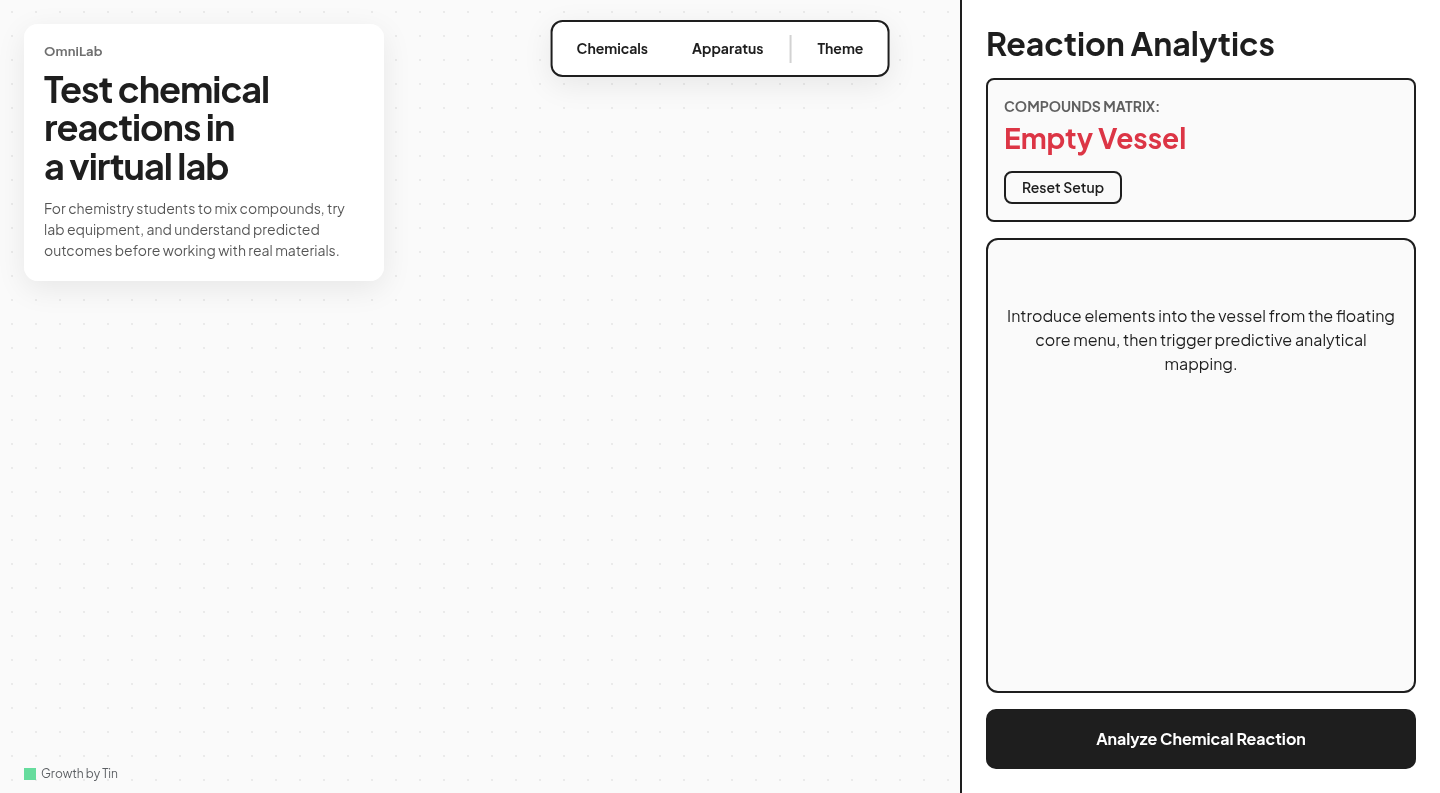
Try the limewater setupThe exact supported pair opens in a beaker. Nothing runs until you select Analyze.
Supported prediction
Ca(OH)2(aq) + CO2(g) -> CaCO3(s) + H2O(l)
What the equation means
Carbon dioxide reacts with calcium hydroxide to form a calcium carbonate precipitate and water. In the common limewater test, the suspended calcium carbonate makes the solution appear cloudy. Excess carbon dioxide can cause further changes that are outside this simplified equation.
Expected observation
A cloudy white precipitate
OmniLab shows a bounded white precipitate cue inside the beaker to represent the expected calcium carbonate solid.
Read the equation
Three details that explain the result
Connect the coefficients and formulas to the gas, solution, and visible cue.
-
Find the solid in the equation
CaCO3 has the (s) state symbol. That means calcium carbonate forms a solid rather than staying dissolved.
-
Check the atom counts
One calcium, one carbon, two hydrogen, and four oxygen atoms appear on each side. Every coefficient is one.
-
Connect the solid to the cloudiness
Small particles of calcium carbonate suspended in the liquid scatter light. The white cue represents that expected precipitate, not a measured amount.
Three safety notes
Read these before any physical experiment
- 01
Avoid breathing calcium hydroxide dust or carbon dioxide-rich air.
- 02
Wear splash goggles and gloves when handling limewater.
- 03
Work with carbon dioxide in a well-ventilated area.
Keep exploring
Connect this observation to another reaction
These guides use the same pattern: predict the equation, identify the visible cue, then check what the virtual model leaves out.
See how the full virtual lab works