Five patterns · Eight questions · Worked answers
Types of chemical reactions practice
Read each equation, name its pattern, then reveal the answer. Each worked answer explains the structural clue rather than asking you to memorize a label.
Start the questionsUse these examples for study. Physical chemistry work needs supervision.
 Actual OmniLab result
A quick method
Look at the number and role of reactants
One product from two simpler reactants suggests synthesis. One reactant splitting into smaller products suggests decomposition. An element replacing another element suggests single displacement. Two compounds exchanging partners suggests double displacement. A fuel reacting with oxygen suggests combustion.
These are classroom patterns, not laws that identify every reaction. A reaction may fit more than one description. For example, hydrogen burning in oxygen forms water and can be called both synthesis and combustion. State your reason and use your course's definition when labels overlap.
Try before you reveal
Eight reaction-type questions
Read the equation first. Then compare your label and reason with the worked answer.
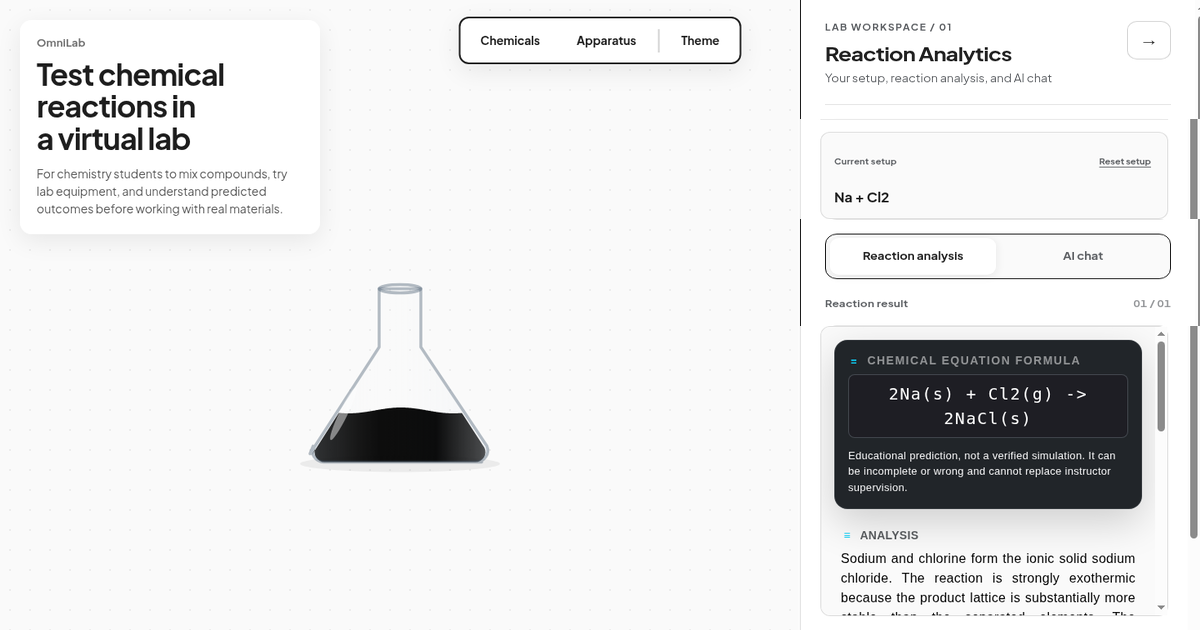
2Na + Cl₂ → 2NaCl
Two elements make one compound. Which pattern best describes the change?
Show the worked answer
Synthesis. Sodium and chlorine combine into one product, sodium chloride. The coefficient 2 balances sodium atoms but does not change the reaction type.
This simplified equation does not describe safe handling or the energy released in a real reaction.
Read the sodium and chlorine guide →CaCO₃ → CaO + CO₂
Heating one compound produces a metal oxide and a gas. Which pattern applies?
Show the worked answer
Decomposition. A single compound breaks into two products. Calcium carbonate must receive heat for this classroom example. Do not expect it to split just because the formula is written.
OmniLab's current two-chemical lab does not model this one-reactant heating process.
Zn + 2HCl → ZnCl₂ + H₂
Which species takes hydrogen's place in the acid?
Show the worked answer
Single displacement. Zinc enters the compound and hydrogen leaves as H₂. Two acid units supply the two chloride ions in zinc chloride.
Hydrogen is flammable. A virtual result cannot establish safe real-world conditions.
Read the zinc and acid guide →Fe + 2HCl → FeCl₂ + H₂
Is this a new pattern or the same pattern as question three?
Show the worked answer
Single displacement again. Iron replaces hydrogen in the acid. Changing the metal changes the products and conditions, but the element-plus-compound pattern stays the same.
Iron's observed rate depends on its surface and the solution. The equation alone cannot predict timing.
Read the iron and acid guide →AgNO₃ + NaCl → AgCl + NaNO₃
Which ions change partners, and what kind of reaction is this?
Show the worked answer
Double displacement. Silver pairs with chloride; sodium pairs with nitrate. In water, silver chloride forms a solid precipitate while sodium nitrate remains dissolved.
The precipitate is a predicted clue, not proof of an unknown sample.
Read the silver chloride guide →HCl + NaOH → NaCl + H₂O
Does the acid-base label replace the structural pattern?
Show the worked answer
Double displacement and neutralization. The ions exchange partners, and H⁺ plus OH⁻ form water. Neutralization describes the chemistry; double displacement describes the common formula pattern.
Amounts and concentrations determine the final pH. This equation does not.
Read the neutralization guide →C + O₂ → CO₂
Which reactant makes combustion the useful label here?
Show the worked answer
Combustion. Carbon reacts with oxygen to form carbon dioxide when oxygen is sufficient. It also has a synthesis shape because two reactants make one product. Combustion tells you more about the oxygen-driven process.
Limited oxygen can lead to different products, including toxic carbon monoxide.
Read the carbon and oxygen guide →2CO + O₂ → 2CO₂
What changes from question seven, and which label still fits?
Show the worked answer
Combustion or oxidation. Carbon monoxide reacts with oxygen to form carbon dioxide. The reactant is already an oxide, so this is not the same starting material as burning elemental carbon. Some courses call this oxidation; explain the oxygen gain if you use that label.
Carbon monoxide is highly toxic. Never use a study prediction as a physical procedure.
Read the carbon monoxide guide →Study boundary
A pattern is a clue, not a full prediction.
These worked answers and OmniLab results are educational predictions. They are not verified simulations. Reactant amounts, temperature, concentration, and other conditions can change a real outcome.
Check your course materials and follow trained supervision. Do not use this page to plan or run a physical experiment.
Next step
Check one reaction in the virtual lab.
Open a supported sodium and chlorine setup, then compare its result with your classification answer.